
STS Forum 2026: Why Trust, Cooperation in Science and Technology, and Young Scientists Matter
STS Forum 2026: Why Trust, Cooperation in Science and Technology, and Young Scientists Matter
The 23rd Annual Meeting of the Science and Technology in Society (STS) Forum was held under the theme “Navigating Tectonic Shifts in Science, Technology, and Society”.
During the Forum, participants attended plenary sessions addressing key issues shaping the future of science and technology. Topics included such as “A World in Transition – Science and Technology for a Sustainable Future”, “Why Trust Science?” and “Lights and Shadows of AI”. Other sessions explored the role of universities in shaping trustworthy AI, as well as the relationship between governments and society and the importance of aligning their priorities.
Participants also took part in concurrent sessions covering a wide range of topics, including “Sustainable Energy”, “Earth and Commons”, “Biomedical Frontiers”, “From Science to Innovative Technologies”, “Cooperation in S&T”, “S&T Education”, “Digital Technologies” and “Impact Investment and Governance”.
One key message emerged: scientific progress encompasses more than just discoveries. It also depends on trust, responsibility, and collaboration.
Speakers of the sessions stressed that people must be able to understand and trust the science behind new technologies, and that this requires open communication from scientists, governments and institutions. They also noted that political tensions should not prevent researchers from sharing knowledge, since challenges such as climate change, water security and emerging health threats cannot be solved by one country alone.
Regarding artificial intelligence, the forum emphasised that rapid progress must be accompanied by clear rules, accountability, and respect for people. AI can support human decision-making, but people must remain responsible for the choices that shape society. The same applies to quantum science and advanced medicine, where safety, privacy, fairness and access must be considered alongside breakthroughs.
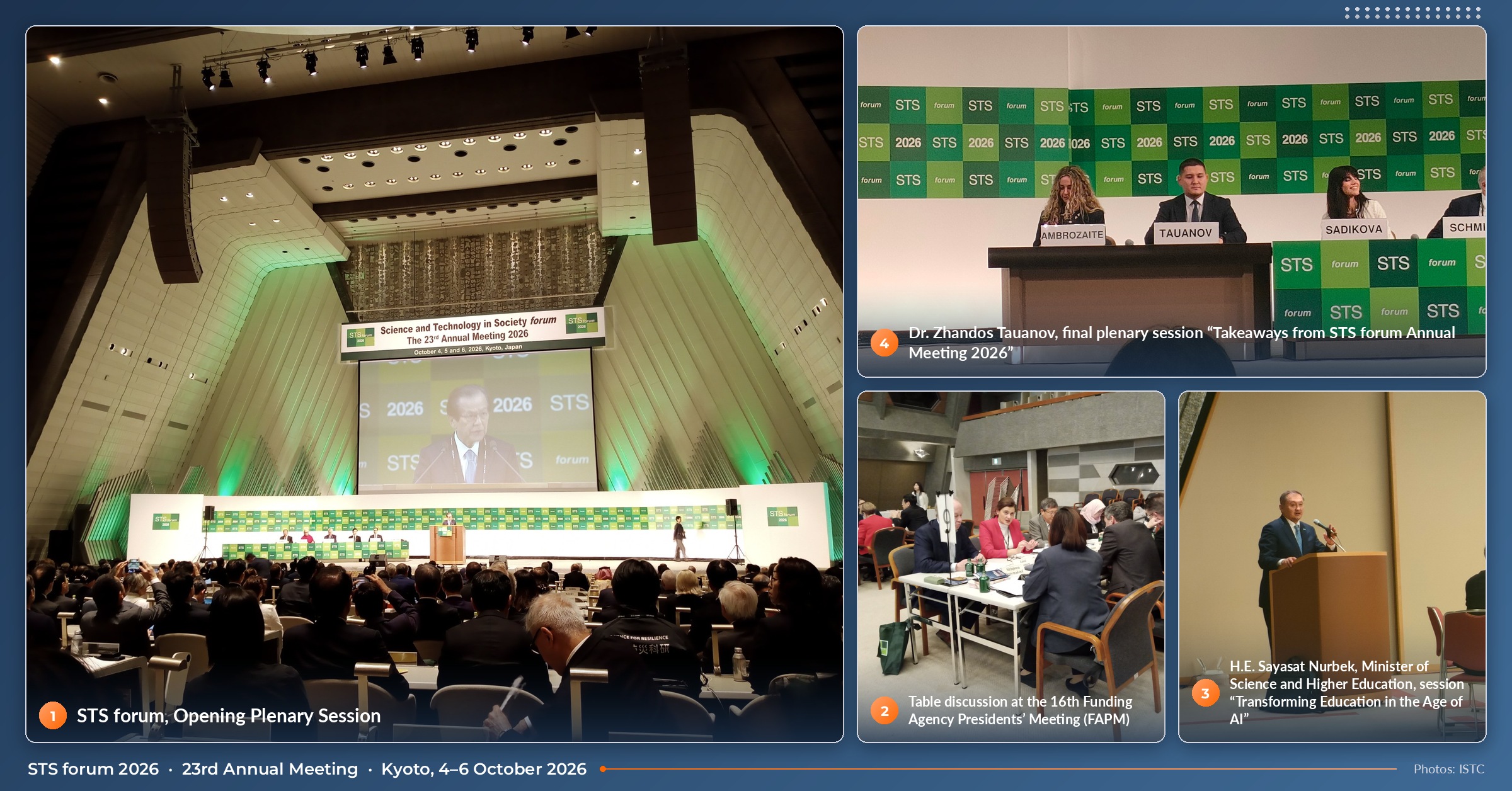
On 4 October, H.E. Sayasat Nurbek, the Minister of Science and Higher Education, spoke at the session 'Transforming Education in the Age of AI', highlighting the need to identify talented young people early on and connect them with leading universities and international research networks so that they can grow to become researchers, innovators and entrepreneurs.
On 5 October 2026, Karina Anguelieva, Executive Director of the ISTC, joined the 16th Funding Agency Presidents’ Meeting, taking part in table discussions on the role of funders in supporting diverse research and impact pathways in the AI era.
ISTC was proud to support two young scientists from Georgia and Kazakhstan through the STS Forum’s Young Leaders Programme. The programme gave them the opportunity to exchange ideas with international experts and participate in the dialogue between young leaders and Nobel laureates.
A particular highlight was Dr. Zhandos Tauanov, Head of the Department of Chemical Physics and Materials Science at Al-Farabi Kazakh National University, being selected to represent the young leaders at the final plenary session of the STS Forum Annual Meeting 2026.
The conclusion of the forum was clear: the future of science is not something we wait for, but something we build together.