
Highlights from the bilateral meetings held during the 23rd Annual Meeting of the STS forum
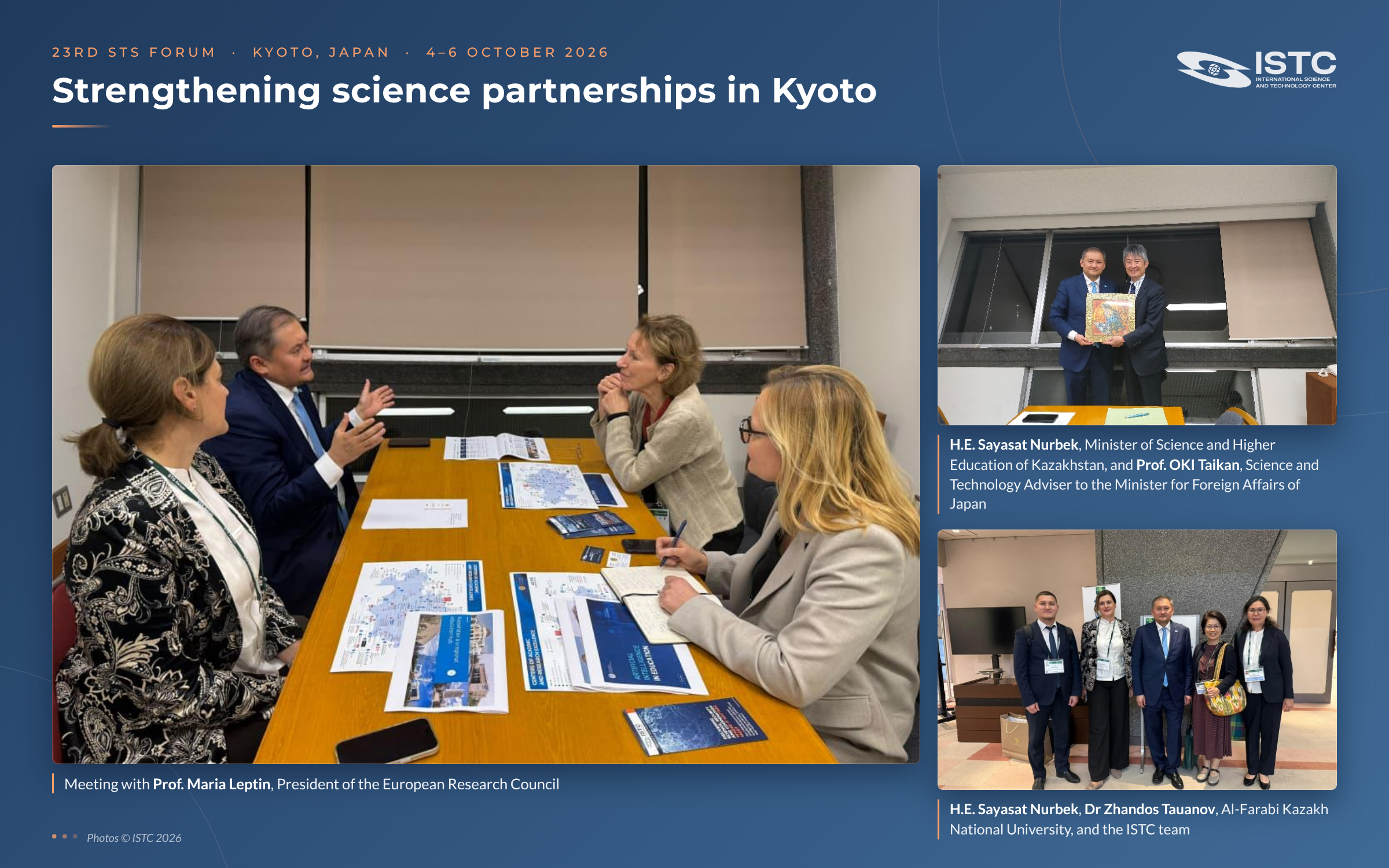
Highlights from the bilateral meetings held during the 23rd Annual Meeting of the STS forum
Established in 2004, the Science and Technology in Society Forum (STS forum) aims to provide a platform for world leaders in policymaking, academia, and industry to gather and discuss how to address science and technology issues for the future of humankind. The 23rd annual STS forum meeting took place from 4 to 6 October 2026 in Kyoto, Japan, bringing together over 1,600 leaders in science, technology, policymaking, business and civil society from more than 80 countries, regions and international organisations.
Karina Anguelieva, the Executive Director of the International Science and Technology Center (ISTC), was invited to the 'Funding Agency Presidents' Meeting', which was held as part of the STS forum. During the forum, several notable bilateral and trilateral meetings were held between the ISTC and representatives from government and international institutions, such as:
- Meeting with Mr KIYOURA Takashi, Director-General, Science and Technology Policy Bureau of the Ministry of Education, Culture, Sports, Science and Technology (MEXT), Japan
Karina Anguelieva provided an explanation of the ISTC’s current status, summarising her one-and-a-half-year assignment as Executive Director. She mentioned the revitalisation of close communication with MEXT since last year, which has resulted in strengthened information sharing between the two institutions. She also expressed deep gratitude for MEXT's contribution to ISTC activities as the sole funder of pure research projects. Ms Anguelieva also informed of the ongoing restructuring of the MEXT-supported Open Call for Proposals, a peer-reviewed, competitive research funding programme, and made suggestions for securing the sustainability of the activities and outcomes achieved through this programme. Mr KIYOURA Takashi, Director-General of the Science and Technology Policy Bureau at MEXT, mentioned the unique role of the ISTC in the Central Asia and Caucasus (CAC) region, and stressed that a priority issue for the Japanese government is strengthening research exchanges between Japanese and CAC researchers. Therefore, MEXT attaches great importance to ensuring that that ISTC projects funded by MEXT bring mutual benefits to science in both the CAC region and Japan.
- Meeting with Prof. OKI Taikan, Science and Technology Advisor to the Minister for Foreign Affairs of Japan
Professor OKI Taikan is a world-renowned hydrologist and laureate of the Stockholm Water Prize. He is also a professor at the Graduate School of Engineering at the University of Tokyo. The meeting was attended by H.E. Sayasat Nurbek, Minister of Science and Higher Education of Kazakhstan, and Karina Anguelieva, Executive Director of ISTC. Having illustrated the demographic growth in Central Asia, including Kazakhstan, which promises a good supply of human capital in the near future, H.E. Sayasat Nurbek expressed a willingness to renew and expand academic and student exchanges between Kazakhstan and Japan. The Kazakh government currently financially supports a non-degree research fellowship programme for Kazakh students and researchers at leading Japanese universities. The Minister explained Kazakhstan’s active engagement in inviting the campuses of leading global universities to Kazakhstan to attract more international students, and its initiative to introduce artificial intelligence (AI) in education to create tailored programmes for each student and an AI literacy programme for faculty members.
- Meeting with Prof. Maria Leptin, President, European Research Council
Professor Maria Leptin, President of the European Research Council, is a professor at the Institute of Genetics at the University of Cologne in Germany, as well as being Director of the European Molecular Biology Organisation (EMBO). The meeting aligned with Kazakhstan’s initiative to strengthen involvement in Horizon Europe programmes. H.E. Sayasat Nurbek stated that nurturing human capital and research innovation is one of the priority issues set out in the new Kazakhstani constitution, with research and development expenditure set at 1% of GDP. He also mentioned the strategy to make Kazakhstani universities more research-intensive and strengthen international joint research by inviting leading global universities to Kazakhstan.
Additionally, the ISTC held bilateral meetings with representatives from the Crop Trust in Germany and the Natural Sciences and Engineering Research Council of Canada. The meetings covered potential collaborations in research partnerships.