
🎓 EDUCATION | From Almaty to Kyoto: A Young Kazakh Scientist Among Nobel Laureates at the STS forum 2026
From Almaty to Kyoto: A Young Kazakh Scientist Among Nobel Laureates at the STS forum 2026
Kyoto, Japan | 3–6 October 2026
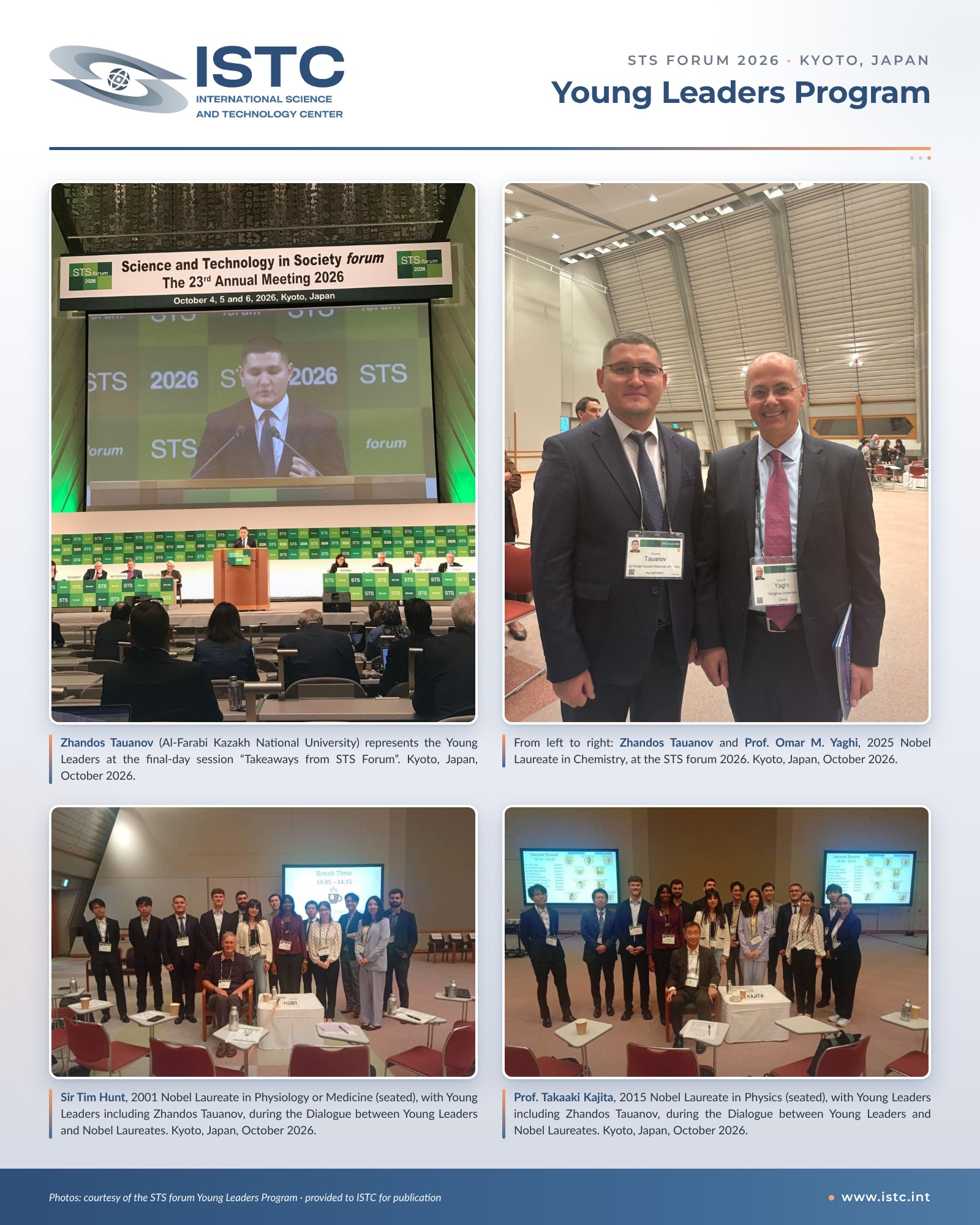
With the support of the International Science and Technology Center (ISTC), Dr. Zhandos Tauanov of Al-Farabi Kazakh National University took part in the Young Leaders Program of the Science and Technology in Society (STS) forum 2026, held in Kyoto, Japan. Now in its 23rd edition, the forum brings together Nobel Laureates, scientists, policymakers, university leaders and industry representatives to discuss the future of science and technology. During the forum, Dr. Zhandos Tauanov exchanged ideas with Nobel Laureates and spoke on behalf of the Young Leaders at the final-day session. Supporting the next generation of scientists and fostering international scientific cooperation are at the heart of ISTC's work. ISTC is pleased to share his reflections, in his own words.
Inspiring the Next Generation of Scientists — by Dr. Zhandos Tauanov
I had the honor of participating in the Science and Technology in Society (STS) Forum 2026 in Kyoto, Japan, as part of the Young Leaders Program, with the generous support of the International Science and Technology Center (ISTC).
The forum brought together Nobel Laureates, leading scientists, policymakers, university leaders, and industry representatives from around the world to exchange perspectives on global challenges and the future of science and technology.
One of the most memorable experiences was the “Dialogue between Young Leaders and Nobel Laureates,” where we had the opportunity to engage with nine Nobel Laureates. I was particularly fortunate to exchange ideas with Sir Tim Hunt (Nobel Prize in Physiology or Medicine, 2001), Prof. Takaaki Kajita (Nobel Prize in Physics, 2015), and Prof. Omar M. Yaghi (Nobel Prize in Chemistry, 2025).
What stayed with me most was not only their remarkable scientific achievements but also their perspectives on the research journey. Our conversations reminded me that scientific progress requires curiosity, creativity, perseverance, and, above all, the courage to believe in one's ideas, even when others may not immediately recognize their potential.
Another important lesson was the value of fundamental research. In a world increasingly focused on immediate results and practical applications, we must remember that many transformative discoveries originate from years of exploration without guaranteed outcomes. Supporting basic science is therefore an investment in future breakthroughs.
I was also honored to be selected to represent more than 100 Young Leaders during the final-day session, “Takeaways from STS Forum,” where I shared my reflections on the discussions throughout the forum. One message particularly resonated with me: periods of transition are also periods of possibility.
Artificial intelligence was central to many discussions. While AI offers extraordinary opportunities to accelerate research and transform education, it must remain under human responsibility and control. I also emphasized that universities should not simply strive to keep pace with technological advancement. Education goes beyond acquiring knowledge; it must develop creativity, critical thinking, practical competencies, and the ability to ask meaningful questions. In the age of AI, knowing what to ask and why may become just as important as knowing the answers.
Finally, the forum reinforced my belief that addressing global challenges requires stronger partnerships among academia, government, and industry, as well as greater international scientific cooperation.
I returned from Kyoto with fresh perspectives, valuable international connections, and renewed motivation to contribute to scientific research and education in Kazakhstan.
The views expressed in this contribution are those of the author.